Recently, Writer and Workplace Intelligence published a survey of 1,600 knowledge workers — 800 C-suite executives and 800 employees — all actively using generative AI at work. One number jumped out.
42% of C-suite executives say adopting generative AI is tearing their company apart.
That's a strong phrase. I don't think it means what it sounds like.
The same survey shows nine out of ten respondents — executives and employees both — are optimistic about their company's approach to AI. People aren't ready to walk away. The technology isn't the problem.
So what does "tearing apart" actually describe?
My read: organizations are fracturing along their existing seams. Quietly, rationally, in parallel. IT is enforcing guardrails that nobody has fully defined. Employees are buying their own tools — 35% are paying out of pocket — because the approved ones don't fit how they actually work. Executives believe the strategy is clear: 89% say their company has a generative AI strategy in place. Only 57% of employees say the same thing.
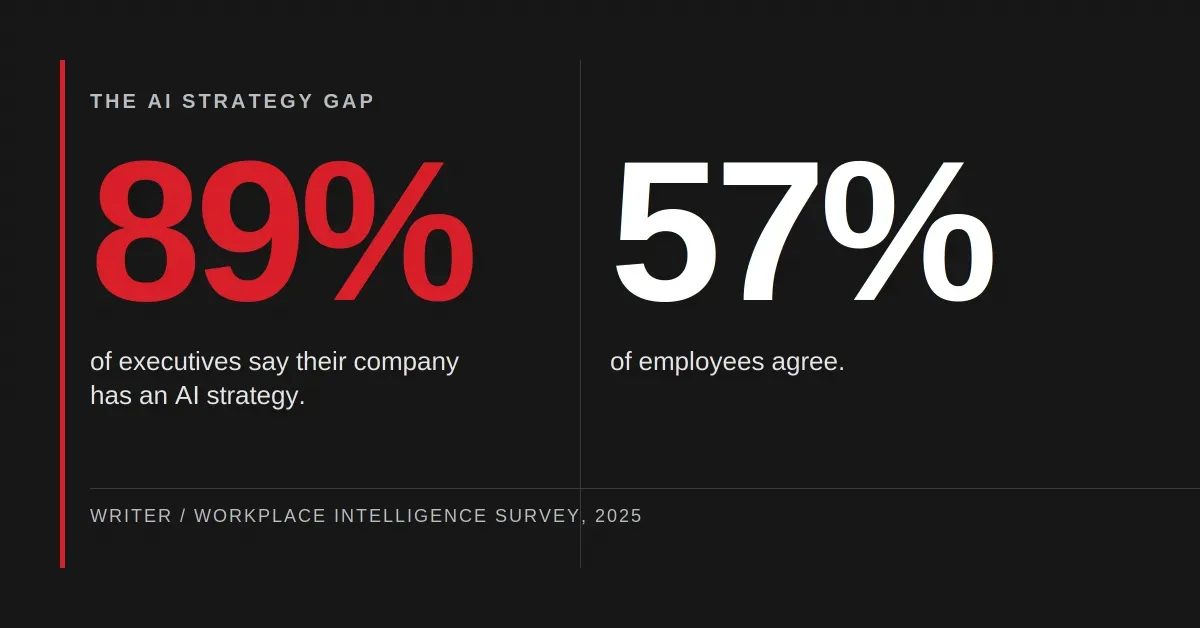
That 32-point gap isn't a communication problem. It's a clarity problem. The strategy exists in a form that makes sense to the people who built it and hasn't been made legible enough for the rest of the organization to act on. Each group does something reasonable from where they sit. None of it adds up.
This isn't a new failure mode
Anyone who has watched a company run on a verbal product strategy has seen this exact pattern. When direction lives in people's heads instead of on the page, every function fills the vacuum their own way. Sales interprets it toward whatever closes deals. Engineering toward whatever is technically interesting. Marketing toward whatever is easiest to position. No one is wrong. Nothing compounds.
AI adoption without a clear strategy runs the same play, just faster and across more functions at once. The survey captures what that produces: 31% of employees say they're actively working against their company's AI strategy. That number hits 41% among Millennials and Gen Z. That's not sabotage in any dramatic sense. That's what disengagement looks like when people have no idea what they're supposed to be doing with AI or why.
The data point that explains most of this
Companies with a formal AI strategy report 80% adoption success. Companies without one report 37%.
That 43-point gap isn't explained by tools or talent. It's explained by whether people across the organization have a shared, explicit answer to three basic questions: what AI tools are available and approved for use, what the guardrails are, and what the company is actually trying to accomplish — what problem it's solving, what success looks like, and why it matters for the people doing the work.
Most companies skip that last question. They announce initiatives, approve platforms, and run pilots. But they don't answer the underlying question in a form that every function can align to. So each team builds its own interpretation.
One more thing the data shows
When asked how their job had changed because of AI, executives and employees described different experiences. Executives reported more time for strategy, faster decisions, and more room for innovation. Employees reported time saved on emails and admin tasks.
Same investment. Two completely different value propositions. Neither was explicitly designed. It's just what happens when you distribute capability before anyone knows what to do with it.
The Writer report is good and worth reading. Their prescriptions — better tools, AI champions, stronger vendor partnerships — all matter. And the 43-point gap in their data suggests that none of those investments will hold without a clear strategy underneath them.