Most scaling companies have a corporate strategy — the market thesis, GTM motion, and growth plan. Many also have a product strategy that translates that direction into what gets built, why it matters, and how investment choices are made.
The problem isn’t whether product strategy exists. It’s whether anyone references it when the VP of Sales and the product team are debating what to build next.
By the time a company is scaling, leadership has usually articulated where the product should go. There’s a deck, maybe a written document, and quarterly updates that outline the direction. Teams have seen it. Leaders can explain it. Yet execution starts feeling heavier than it should.
Decisions slow down. Priorities shift without clear rationale. The roadmap becomes harder to defend, even when everyone is acting in good faith.
What’s breaking down isn’t effort or intent. It’s that product strategy has stopped functioning as a decision-making tool.
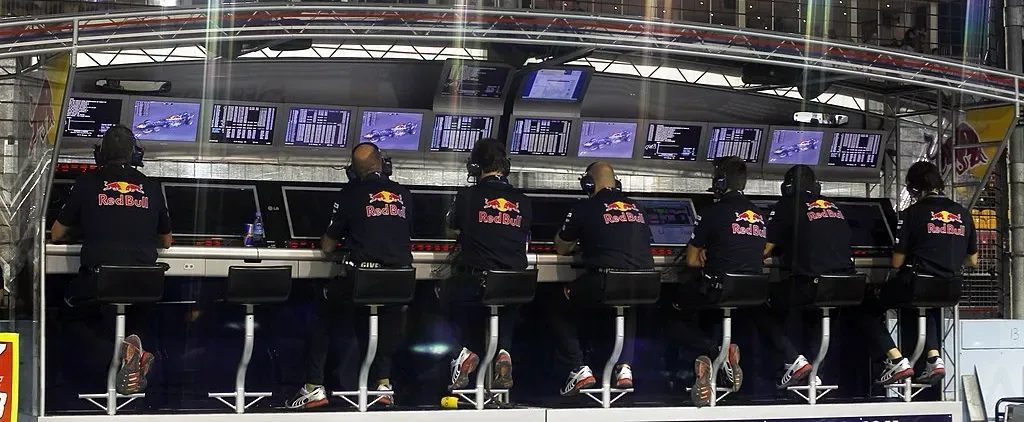
Strategy is the pit wall for product decisions: a shared view that resolves tradeoffs in real time. [Photo: “Red Bull team on the pit lane wall — 2010 Singapore Grand Prix” (LG전자 / Formula 1™), CC BY 2.0, via Wikimedia Commons. Cropped.]
When Product Strategy Stops Coordinating Decisions
As companies scale, more decisions get made without the full context leadership holds. Teams operate in parallel. Tradeoffs get made under pressure, with incomplete information, by people doing their best with what they have.
When product strategy isn’t internalized, when people can’t draw a direct line from what they’re building to why it matters strategically, they fill in the gaps themselves. Not irresponsibly. But based on their own vantage point.
Here’s what this looks like: The VP of Sales sees a customer request that could close a deal. The product team has prioritized work that doesn’t drive immediate ARR but unlocks a capability the product strategy requires. Both choices are defensible. Both might even support the strategy. But without a shared frame of reference, the discussion becomes a standoff.
The loudest voice wins. Or the CEO picks the customer request because the revenue is right there. Or someone agrees in the moment but slow-rolls execution later, setting up the inevitable “I told you so.”
The cost shows up weeks or months later. A strategic capability gets delayed. Tech debt resurfaces as a bigger problem. Sometimes you get a major outage that sets everything back. Meanwhile, trust in the roadmap erodes. Teams stop believing priorities will actually hold.
This isn’t misalignment in the traditional sense. People aren’t confused about the overall direction. They’re operating from different interpretations of how product strategy should shape tradeoffs in the moment.
Why This Gets Worse as You Grow
Early on, proximity does most of the work. Leaders are close to the details. Decisions happen quickly. Product strategy can live mostly in people’s heads because shared context keeps everyone close enough to move forward.
That stops working as the organization grows.
Product strategy may still feel clear at the executive level, but it weakens as a tool for guiding daily decisions. Teams understand the direction in broad terms but struggle to apply it when sequencing work, saying no to reasonable requests, or explaining why one thing takes priority over another.
Multiple interpretations of product strategy begin circulating, shaped less by what leadership articulated than by each function’s incentives and immediate pressures.
Strategy hasn’t disappeared. It’s just stopped coordinating decisions.
From Document to Decision Tool
Writing product strategy down matters. Sharing it across the company matters. But neither guarantees it will guide decisions when it counts.
Product strategy starts functioning when teams expect to use it, not just acknowledge that it exists. When the sales VP and product leader are in a standoff can both point to the same strategic frame and debate which option better supports it. When “this supports our focus on X” becomes a normal part of prioritization discussions instead of something leadership restates every time.
That shift happens when two things consistently show up in the room.
First, options get evaluated with their strategic implications visible. Not justified after the fact, but discussed upfront. If the customer request accelerates a strategic capability, that’s explicit. If the product team’s work is a prerequisite for what comes next, that’s explicit too.
Second, the product strategy itself is specific enough that people can actually apply it to real tradeoffs. “We’re focused on enterprise customers” is a direction. “We’re building the workflow orchestration layer that lets enterprise customers consolidate three tools into one” is something you can use to choose between two good options.
The difference matters. One lives comfortably in decks and updates. The other coordinates decisions across Product, Engineering, Sales, and Customer Success when leadership isn’t in the room.
What to Watch For
If you’re wondering whether your product strategy is functioning as a decision tool or just existing as a document, here’s what reveals the truth:
In prioritization meetings, does anyone reference the product strategy as a reason to choose option A over option B? Or do discussions stay focused on effort estimates, urgency, and stakeholder volume?
Can your product team explain, without pulling up a deck, which part of the strategy a given initiative supports? If they have to pause or check, the strategy isn’t internalized.
When priorities shift, can someone name what’s being deprioritized and why the tradeoff makes strategic sense? Or do changes happen informally, creating the illusion of progress without actual momentum?
Do cross-functional disagreements resolve faster when people debate trade-offs within a shared frame? Or do they stall because everyone is trying to reconstruct what leadership meant?
The pattern reveals itself quickly. If product strategy only comes up when leadership is in the room, it’s not doing its job. And that gap gets expensive as the company scales.