In Stage 4 of the 1983 Manx Rally, Terry Harryman is doing what navigators do. Reading pace notes. Calling corners before Ari Vatanen can see them. Staying ahead of a car moving at over 100 mph on wet island roads.
Then the Opel Manta 400 clips a cattle grid, breaks loose, and slides toward a gap in the stone walls that looks considerably narrower than the car.
Harryman says, almost calmly: "Oh, dear God."
Vatanen threads it. They finish the stage on a puncture. Harryman goes straight back to the notes.
The reason it works, the reason Vatanen can recover and Harryman can continue, is that the navigator never stopped being ahead of the car. His job is not to describe what's happening. It's to call what's coming before the driver can see it.
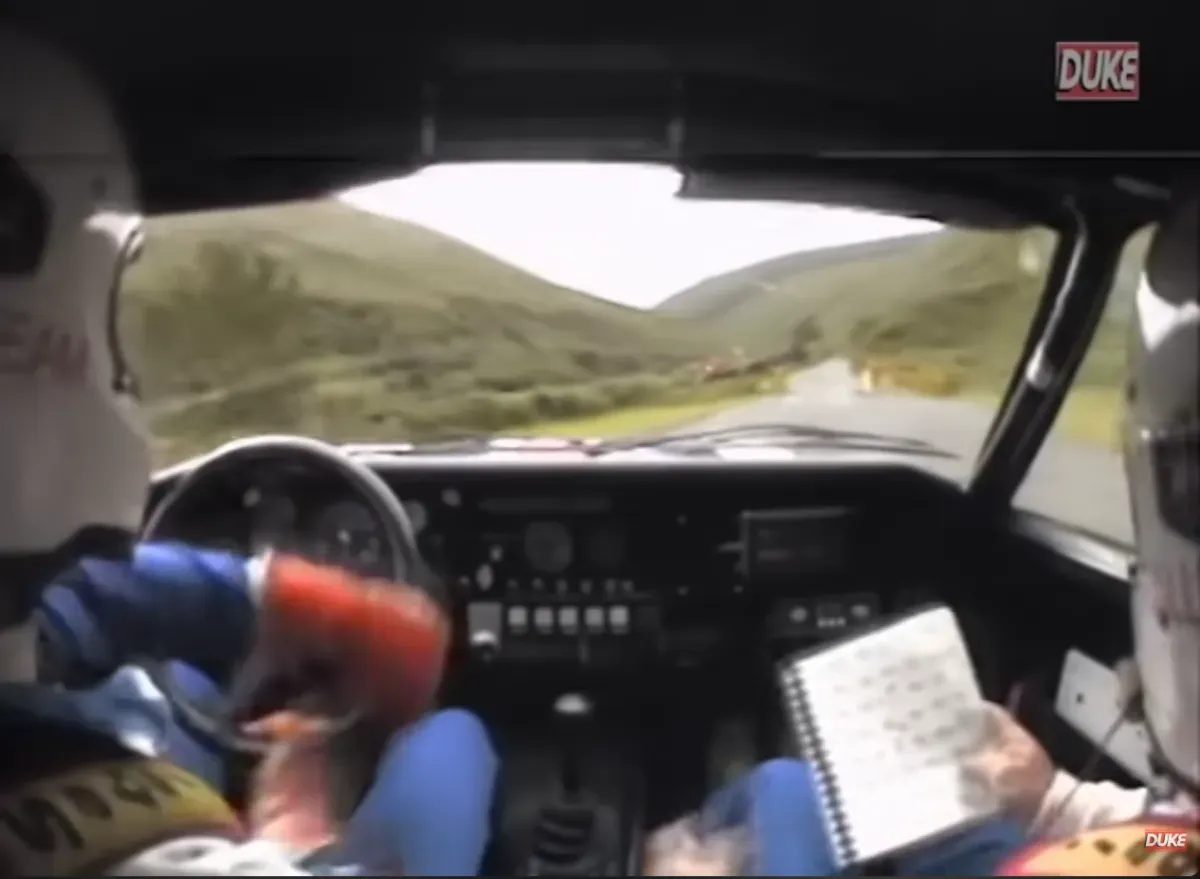
Harryman's job wasn't to describe the slide. It was to call the road before Vatanen could see it. Still from "Oh Dear God" — Ari Vatanen / Terry Harryman, Stage 4, 1983 Manx International Rally. Via Duke Video: https://www.youtube.com/watch?v=cxDz0Z066NI
Most AI roadmaps are built the other way around.
Most B2B SaaS companies have an AI roadmap. Most of them built it by working from three inputs: what competitors are shipping, what a stakeholder prototyped last weekend, and what the board asked about in the last meeting.
Those are real inputs. None of them is wrong. But none of them answers the question that actually determines whether the investment pays off.
That question is: where does AI make this specific product harder to replace?
Why does the question get skipped?
It gets skipped because it's genuinely hard to answer. The other inputs are fast and concrete. A competitor's launch is visible. A working prototype is tangible. A board question is immediate. The defensibility question requires doing real work to find what's genuinely hard to replicate about a specific product in a specific market, and most companies haven't done that work in a form they can actually use.
It also gets skipped because the activity gets mistaken for an answer. "We're the only ones with X integration" sounds like a moat. "Customers say they love our workflow" sounds like retention data. "We have the most data" sounds like defensibility. None of those is wrong as an observation. None of them is specific enough to guide AI investment.
The two types of AI investment
There are two fundamentally different things that AI investment can do, and most roadmaps can't tell them apart.
The first type strengthens something the product already does that customers genuinely depend on. It makes a sticky workflow faster. It reduces the friction that drives churn. It embeds the product more deeply into something customers can't easily move away from. AI applied here compounds. The product becomes more important with each iteration. Customers don't just notice it. They rely on it.
The second type adds capability customers notice but don't depend on. It improves the demo. It makes the product look current. It might help in a sales cycle. AI applied here produces a better first impression and a flat NRR. And because every competitor has access to the same underlying models, any advantage is short-lived.
Positioning value is real. The problem is that most companies don't know which type they're building. They build both and call it an AI strategy.
What happens when you can't tell them apart
When there's no shared answer to the defensibility question, prioritization becomes political. Every AI request feels equally valid. The loudest voice wins. The board conversation is narrative rather than evidence. A year of roadmap activity produces a list of shipped features and a flat competitive position.
McKinsey's State of AI 2025 reported that 64% of companies said AI is enabling innovation, while only 6% said they've achieved meaningful business impact. That 58-point gap is not an execution gap. The features are shipping. The demos work. It's a strategy gap. Specifically, the gap between investing in AI and knowing where AI investment will actually matter.
What the defensibility question requires
Answering it requires an honest look at the product. Not at what sounds good in a board deck, but where customers actually rely on the product in ways they can't easily replicate or work around.
Where are the workflows genuinely embedded? What proprietary signals or data exist that a competitor can't access? Where is the friction of switching high enough that customers stay even when a comparable alternative exists? What does the product do that customers have built their own processes around?
Those answers exist. They're usually not in a strategy document. They live in the sales team's loss analysis, in the patterns customer success sees in escalations, in what engineering knows about what makes the core hard to rebuild.
Getting to those answers is the work that must be done before the AI roadmap is set. Not after, not in parallel. Before.
The companies getting AI ROI right now
They share one characteristic. They didn't start with the AI roadmap: they started with the defensibility question, and the roadmap followed.
AI applied to a real, defensible position compounds. Each investment makes the product harder to replace. Customers build more dependence on it. Win rates improve. NRR holds. The board conversation has answers behind it, not just narrative.
If your AI roadmap was built before that question was answered, you're not behind. You're just starting in the wrong place.
The first step is an honest answer to the question that the current roadmap skipped.