You know the feeling. Sales walks in with feature requests from a big deal. Support's showing you the same friction point for the twentieth time. Engineering knows exactly what would make the platform faster. Leadership wants to place a bet that could move you into a new category.
In the room, it feels like momentum. Everyone's paying attention. The market's pulling.
But when you look at what actually ships, it doesn't feel like momentum at all. A lot of activity, not much change in the results.
Here's what I've learned: this isn't because the ideas are bad. It's because "good ideas everywhere" creates a new problem—you need a way to compare those ideas, put them in order, and say no without re-litigating the entire roadmap every single week.
When you don't have that, the organization just steers toward whatever input is loudest right now. A competitor announcement. A board question. A production incident. The direction shifts a little, then a little more. Everyone stays busy. The product doesn't get clearer.
The usual fixes don't work
Most teams reach for the obvious moves: tighten the roadmap, improve prioritization, add more governance, run more alignment meetings.
Sometimes those help. But they don't solve the actual issue, which is both simpler and harder:
Product strategy isn't a document. It's the coordination layer for decisions.
Many teams have strategy artifacts. A deck with pillars. OKRs. A north star metric. Those are often the beginning of a strategy, and sometimes they're evidence that a strategy exists.
But the real test is what happens on a normal Tuesday when two good requests conflict.
Do people know what to optimize for without escalating? Can they explain a "no" in a way that feels consistent, not political? Do they have a shared definition of success?
When the answers are fuzzy, each function fills in the gaps with its own logic. Sales optimizes for closing this quarter. Customer Success optimizes for reducing churn. Engineering optimizes for stability. Marketing wants a sharper story. Leadership wants to take a bet that could reposition the company.
None of that is wrong. The problem is it's all happening at once, without a consistent set of tradeoffs. The decisions don't add up. The roadmap doesn't hold.
Process can't save you
I've watched teams try to "process" their way out of this. More intake forms. More templates. More scoring frameworks. More meetings.
Process can make chaos feel orderly. It gives people a place to put requests. It creates the illusion of control.
But if the strategy isn't functioning as a shared set of decision rules, the process just becomes a stage where you have the same debate over and over with new slides.
You know you're here when priorities reshuffle every quarter, roadmaps churn, teams ship things, but outcomes don't move, and nobody trusts commitments anymore. Product becomes a negotiation function because negotiation is the only way to resolve conflict.
This is also where roadmap conversations get stuck—everyone's arguing about the plan instead of the decisions behind the plan.
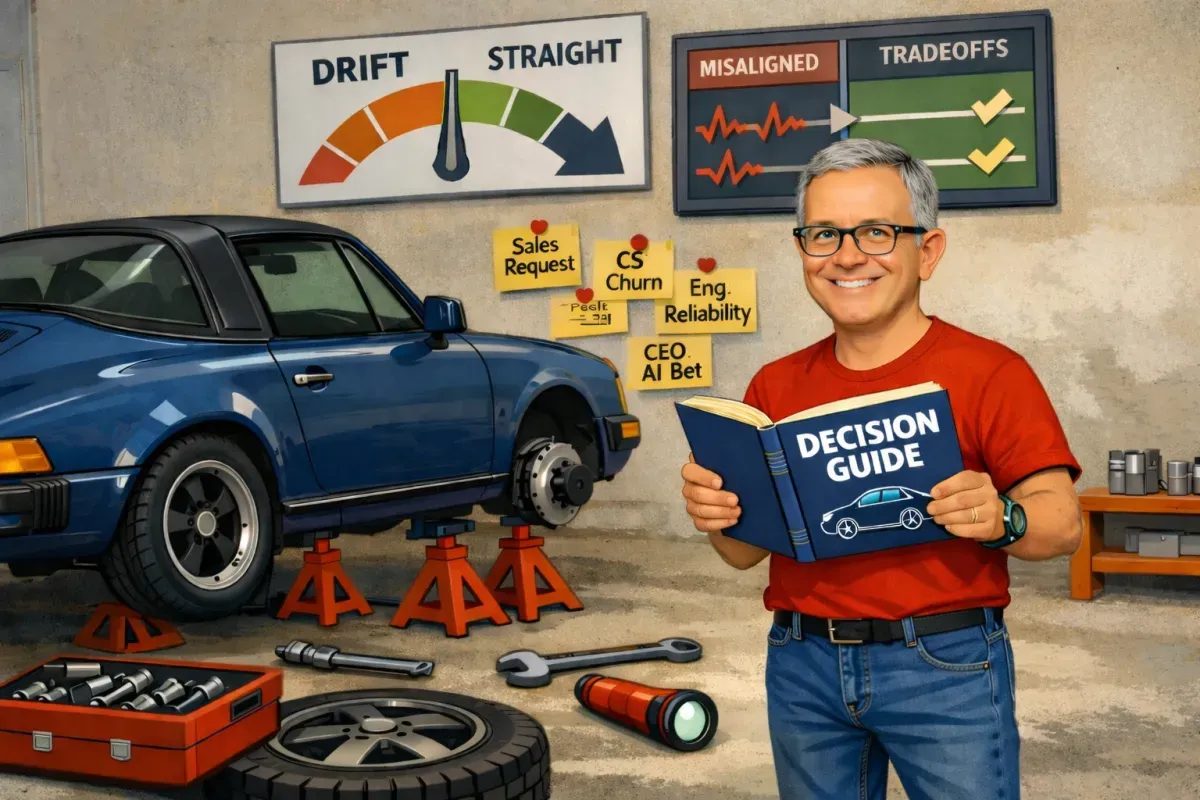
The roadmap is a record of decisions, not a pile of parts.
Your roadmap needs to be a record of decisions
At some point, a roadmap has to be more than a list of work.
Not just "what we're doing," but "what we're not doing and why." Not just "what's next," but "what has to be true first." Not just "we shipped it," but "what did we learn, and what does that unlock?"
When that decision layer is visible, the roadmap becomes defensible. You can take in new information without collapsing the whole structure because the tradeoffs are already explicit.
When it isn't visible, every new input forces a renegotiation of everything.
If this sounds familiar, you've probably lived some version of this meeting:
Sales is pushing for enterprise features tied to late-stage deals. Customer Success wants onboarding improvements because new customers are churning early. Engineering needs reliability work because incidents are increasing. The CEO wants an AI capability because competitors are talking about it.
Everyone has evidence. Everyone has urgency. Everyone's being rational.
And the product leader gets stuck playing the role of mediator.
The conversation drifts toward compromise. "Can we do a little of each?"
It produces a roadmap that looks fair but performs poorly. It fragments execution, dilutes the narrative, and increases coordination overhead. A few weeks later, the dates slip, the arguments return, and the next roadmap meeting gets even harder.
That's not a talent problem or a motivation problem. It's not even a "prioritization framework" problem.
It's what it looks like when the coordination layer is missing.
Where to start
If you want a practical next step, don't start with a big re-org or a new process.
Start by reducing uncertainty: identify where your product system is straining, so you can decide what to address first.
I built a short diagnostic that maps the common strain patterns that show up when strategy isn't coordinating decisions as you scale.
Find it here: apexsol.io/where-your-product-system-is-breaking